Tree Removal in Waldorf MD: Every Question Answered

Real questions from local homeowners. Straight answers. No jargon, no sales pitch.

☎ Call (240) 213-4913

Get a Free Estimate

Tell us about your tree. Free estimates, no pressure.

Call or text now
(240) 213-4913
Serving Waldorf and Charles County, MD
Up to 3 photos — helps us give a faster, more accurate estimate.
Every project is different — contact us for a free written estimate.
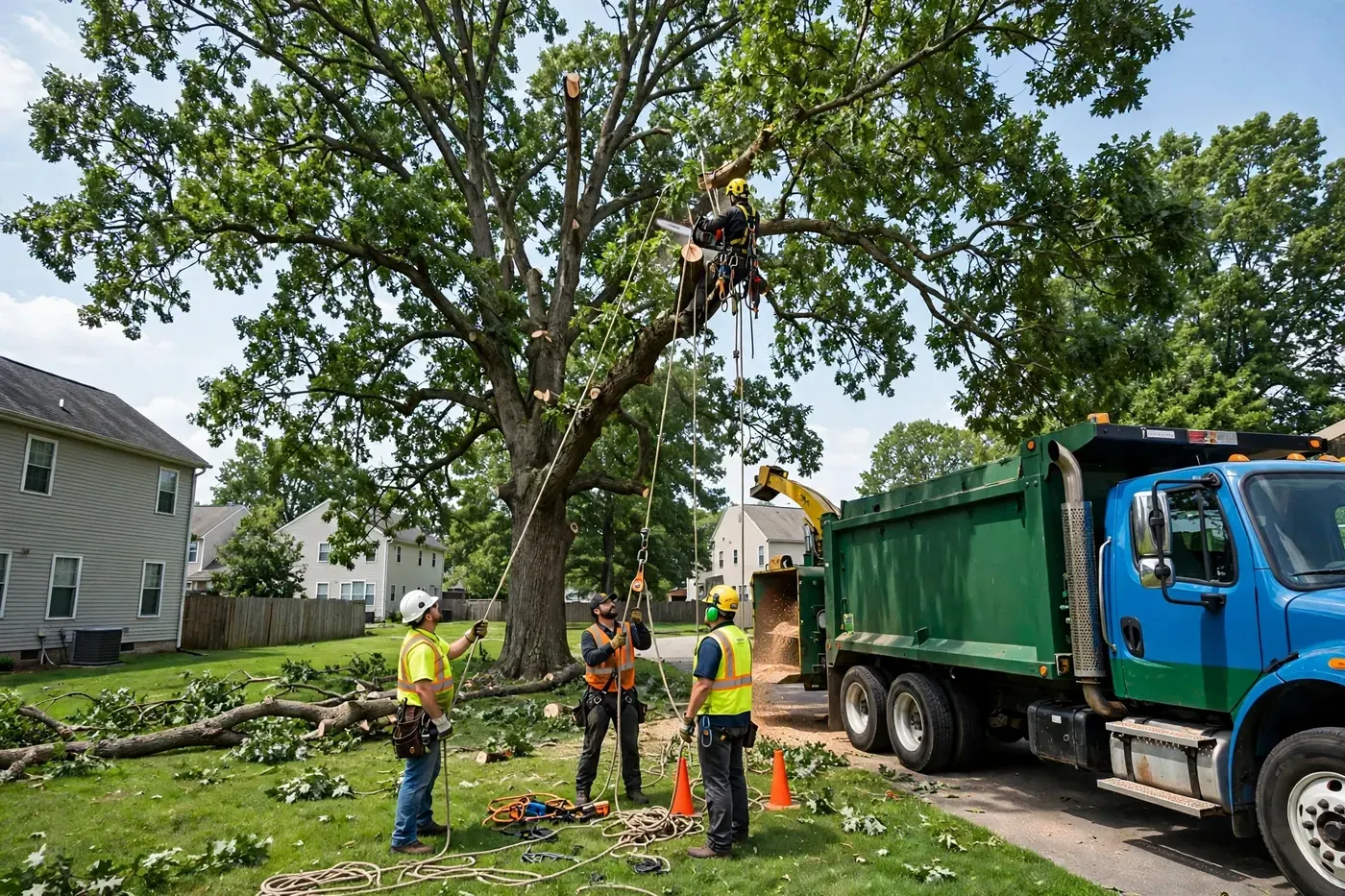
Tree service crew removing a large oak tree at a suburban Maryland home

What does tree removal cost? Do I need a permit? Will insurance pay? These are the questions Waldorf homeowners ask us every week. This page answers all 24 of them in plain English — the same straight answers you would get if you called us.

Short on time? The fastest answer is still a free on-site visit: we look at your tree and give you a written price. Call (240) 213-4913.

Tree Removal Costs

A note on prices: material and labor costs move up and down, and no two trees or yards are alike. Treat any numbers on this page as starting points from published cost guides — not quotes. Your free on-site written estimate is the real number for your job.

For the full breakdown, see our tree removal page and our tree service cost guide. Adding stump work to the job? See stump grinding.

Remove It or Save It?

The hardest question is not the price — it is whether the tree has to go at all. We would rather save your tree than sell you a removal, and we will tell you straight when pruning can do the job. Our when-to-remove-a-tree guide walks through the decision step by step. If the answer is a trim instead, see tree trimming.

Permits and Maryland Tree Rules

For a normal tree in your own yard, Charles County does not ask for a permit. The one big exception is the roadside: trees along public roads are protected by Maryland's Roadside Tree Law. Our Charles County permit guide explains the rules in plain English — what needs a permit, who handles roadside trees, and what the fines look like.

Insurance, Storms, and Emergencies

After a storm, two questions matter: is anyone in danger, and who pays? If a tree is on your house right now, that is what our emergency tree service is for — we make the site safe first. If the danger has passed and you are staring at a mess, see storm damage cleanup. Take photos before anything is cleared — your insurance company will want them.

Hiring a Tree Company

Maryland law says anyone doing tree care for pay must hold a Maryland Tree Expert license from the state. The questions below are the checklist we recommend for any company you consider — including us. Ask them all. A good company answers without blinking. Ready to talk? Contact us for a free on-site visit.

After the Job

What happens to the wood? Does the stump grow back? Is cleanup really included? The answers are below — and the short version is: you choose what happens to the wood, a proper grind ends regrowth, and our written price spells out the cleanup so there are no surprises. Details on our tree removal and stump grinding pages.

Get your free estimate

Still have a question we did not answer? Call (240) 213-4913 — you will talk to someone local, not a call center. Free on-site visit, written price, no pressure.

Frequently Asked Questions

How much does tree removal cost in Maryland?

Most homeowners pay between $200 and $2,000 for a tree removal, based on national cost guides. Small trees sit at the low end. Big oaks near a house sit at the high end. Prices move with the market, and every tree and yard is different — your free on-site written estimate is the real number for your job.

How much does tree removal cost by tree size?

Size drives the price more than anything else. A small tree under 30 feet often runs $150 to $450. A medium tree, 30 to 60 feet, often runs $285 to $700. A large tree, 60 to 80 feet, often runs $700 to $1,200. A very large tree over 80 feet can run $1,000 to $2,000 or more. These are national ranges, not quotes — your free on-site estimate gives you the real number.

How much does stump grinding cost?

Most stump grinding jobs run $195 to $600, based on national cost guides. Small stumps cost less. Wide stumps and hard-to-reach spots cost more. Grinding the stump at the same visit as the removal almost always costs less than booking a second trip later. Prices move and every job differs — your free written estimate is the real number.

Is stump grinding included in the tree removal price?

Not always. Some companies price removal and grinding together. Others price the stump as a separate line. Ask for the written price to spell it out. If grinding is not in the quote, ask what it would add — and compare the total, not just the removal number.

Is tree removal cheaper in winter?

Often, yes. Winter is the slow season for tree crews, so some companies offer better rates. Winter is also the best time to prune most trees — the leaves are gone, the tree is resting, and frozen ground means less damage to your lawn. But a dead or risky tree should never wait for winter. Safety comes first, any month.

How much does it cost to remove a fallen tree?

A fallen tree with nothing on it usually costs less than a standing removal — the cutting is simpler. But it depends on the size of the tree, where it landed, and how much hauling is involved. If the tree is tangled in a fence, a shed, or power lines, the price goes up. Call for a free on-site written estimate — that is the only real number.

Should I trim my tree or remove it?

Trim it if the trunk is solid and the problems are only in the branches — dead limbs, limbs over the roof, a lopsided crown. Remove it if the trunk is hollow, the roots are failing, or the tree is dead. When in doubt, get a free on-site visit. We will tell you straight — if pruning can save your tree, we say so.

What are the signs a tree needs to be removed?

The big ones: no leaves in spring while other trees are green, bark falling off in sheets, mushrooms growing at the base, a trunk that sounds hollow, a lean that keeps getting worse, deep cracks in the trunk, and roots lifting your driveway or sidewalk. One sign may be nothing. Two or three mean it is time for a pro to look.

Can a dead tree be saved?

No. Once a tree is truly dead, it will not come back. The real question is whether the tree is dead or just stressed. A tree with no leaves in summer and brittle branches that snap is likely dead. A tree with thin leaves may just be sick — and that tree might be saved. We check each tree limb by limb and tell you which one you have.

How can I tell if a leaning tree is dangerous?

A slight lean that has been there for years is often normal — the tree grew toward the light. A new lean, or a lean that keeps getting worse, is not normal. Check the ground on the opposite side of the lean. If the soil is cracked or lifted, the roots are failing and the tree may fall. Call us. We will read the lean and tell you straight.

My tree was damaged in a storm — can it be saved?

Sometimes. If the trunk is solid and only limbs were torn off, pruning the broken wood back to clean cuts can give the tree a real second chance. If the trunk is split, the tree is uprooted, or half the crown is gone, removal is usually the safer call. We look at storm-damaged trees for free and give you an honest answer either way.

Do I need a permit to remove a tree in Maryland?

For a normal tree in your own yard in Waldorf, no — Charles County does not require a permit for routine residential tree removal. The exception is roadside trees: any tree growing all or partly in a public road right-of-way needs a Tree Care Permit from the Maryland DNR Forest Service before it is touched. Trees near streams, wetlands, or protected areas can have extra rules — when in doubt, check with Charles County before work starts.

What is the Maryland Roadside Tree Law?

It is a state law from 1914 — the first of its kind in the country. It protects trees that grow all or partly in a public road right-of-way. Before anyone trims, removes, or cares for a roadside tree, they need a Tree Care Permit from the Maryland DNR Forest Service. Work done for pay must be done by a Maryland Licensed Tree Expert. Cutting a roadside tree without a permit can bring fines of up to $2,000 for a first offense. (Sources: Maryland Natural Resources Article 5-406; MDOT State Highway Administration.)

Who handles trees in the public right-of-way?

The roadside belongs to the county or the state — not to the homeowner, even when the tree stands in front of your house. You cannot cut it yourself. For a tree along a county road, contact Charles County. For the permit itself, the Maryland DNR Forest Service runs the process. Trees touching power lines belong to the utility company — call them, and stay far away.

Does homeowners insurance cover tree removal?

Sometimes — usually after storm damage. Most policies pay to remove a tree that fell on your house, garage, or fence. Many also pay a set amount for debris cleanup, even if the tree missed everything. What policies almost never pay for is removing a healthy or dead tree before anything happens — that is maintenance, and it is on the homeowner. Check with your agent about your own policy. We give you a written record of the work for your claim.

Will insurance pay if a tree falls but hits nothing?

It can. Many policies include debris removal coverage — often a few hundred dollars per tree, up to a set limit — even when the tree missed the house. The coverage is usually smaller than when the tree damaged a structure. Take photos before anything is cleared, keep our written invoice, and ask your agent what your policy includes.

My neighbor's tree fell on my property — who pays?

In most cases, your own insurance handles the damage to your property — not your neighbor's. That surprises people. The exception: if the tree was clearly dead or dangerous and your neighbor knew it and did nothing, they may be on the hook. That is why a written warning to the neighbor matters — it creates a record. Maryland follows the 'self-help' rule: you can trim branches that cross onto your side, back to the property line, but you may not cut down the tree itself.

A tree fell on my house — what should I do?

First, make sure everyone is safe. Stay away from the tree — and stay far away from any downed power lines; call 911 for those. Second, take photos of everything before anything is moved. Third, call us so we can make the site safe — a tree on a roof is dangerous to move without a crew. Fourth, call your insurance agent and start the claim. We give you a written invoice that documents the work for your file.

What license should a tree company have in Maryland?

Maryland law says anyone doing tree care for pay must hold a Maryland Tree Expert license from the state Department of Natural Resources. To get it, they pass a written exam and carry liability and property damage insurance. The license renews every two years. Ask to see the license before work starts — and know you can look a company up on the DNR website. (Source: Maryland DNR Forest Service.)

What should I ask before hiring a tree company?

Ask these eight questions before anyone touches your tree. 1) Are you a Maryland Licensed Tree Expert? Show me the license. 2) Show me proof of liability and workers' comp insurance. 3) Will I get a written price with the full scope spelled out? 4) Is cleanup and hauling included — or extra? 5) How will you protect my house, fence, and yard? 6) Who is actually doing the work — your crew or a subcontractor? 7) How much is the deposit? Never pay the full amount up front. 8) Can I see recent work or talk to a past customer? A good company answers all eight without blinking.

What is the difference between a certified arborist and a regular tree company?

A certified arborist passed an exam from the International Society of Arboriculture and keeps up with training — it is a mark of tree knowledge. A Maryland Licensed Tree Expert passed the state's exam and carries the insurance the state requires — it is the license the law demands. One person can hold both. When you hire, the license is what the law requires and the certification is a strong plus. What matters most: licensed, insured, a clear written price, and a crew that answers your questions straight.

What happens to the wood after a tree is removed?

That is your choice. Most jobs: the brush goes through the chipper, the trunk is cut into logs, and everything is hauled away — yard left raked and clean. Want firewood? Ask us to cut the logs to firewood length and stack them for you. Want mulch? Keep the wood chips for your beds. Say what you want during the visit so it is in the written price.

Can a tree grow back from the stump?

It can sprout, but it will not grow back into a tree. Some hardwoods push up small shoots — called suckers — from a stump or its roots. That is why we grind 6 to 12 inches below ground level: at that depth, regrowth is very unlikely. Full removal of the root ball ends it completely. If you see suckers after a grind, call us and we will make it right.

Is cleanup included in the price?

It should be — but not every quote includes it, so ask. Our written price spells out the cleanup: brush chipped, logs hauled, chips raked level, driveway blown off. Ask any company these exact words: 'Is chipping, hauling, and raking included in this price?' If the answer is vague, the cleanup is probably an extra charge you will meet later.

☎ Call (240) 213-4913