
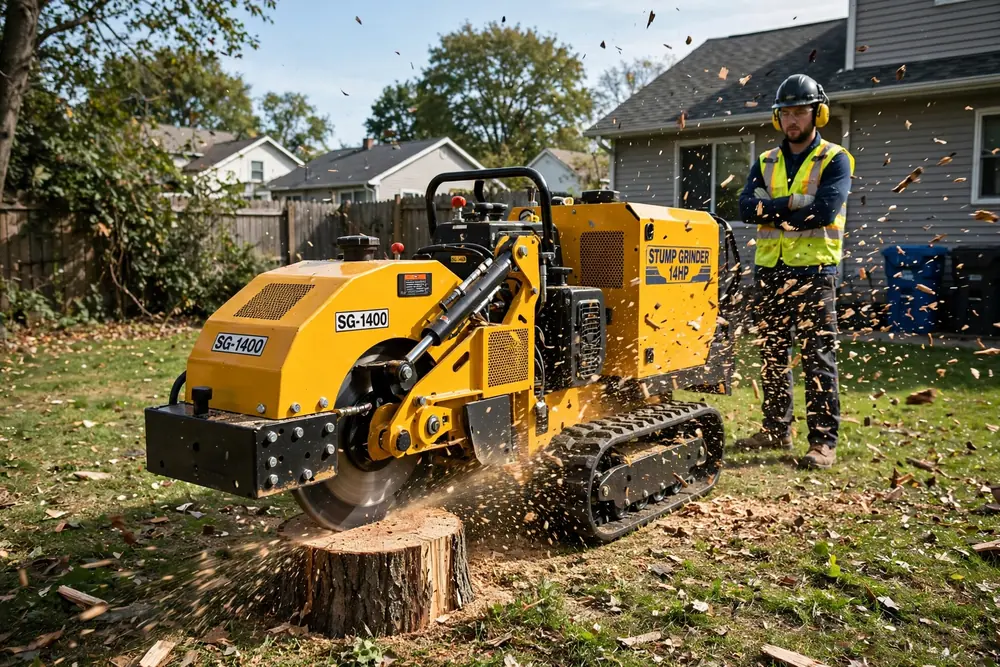
Roots do not stay where you planted the tree. They spread — under the driveway, into the flower bed, toward the sewer line. One day your walkway has a hump in it. The next, a root has cracked the patio. Root removal fixes the damage. We find the problem roots, cut or grind them out, and repair the surface. One honest warning up front: a tree needs its roots. We remove only what is safe, so the tree stays standing and healthy. Call or text (240) 213-4913 for a free on-site look.
What Is Root Removal?
Root removal is the fix for roots that have already caused damage. Roots lifting your driveway. Roots cracking the patio. Roots in the sewer line. Roots making the mower bounce. We expose the problem roots, cut them back, and grind down what is left at the surface. Then we repair the area — fresh soil, leveled ground, ready for grass or new concrete.
This is different from root barrier installation, and the difference matters. Root removal cures the problem you have now. A root barrier prevents the next one. A barrier is a shield we bury in the ground that steers future roots away from your driveway or foundation. If roots already lifted your walkway, removal fixes it. If you are pouring a new walkway and want roots to stay away, that is a barrier job. Many jobs need both: remove the damage, then install a barrier so it does not come back. Our root barrier installation page explains the prevention side.
When You Need It
- Roots are lifting your driveway, walkway, or patio slabs.
- Surface roots turn mowing into a bouncing, blade-dulling battle.
- A plumber found roots in your sewer or drain line.
- Old stump roots keep sending up new shoots across the yard.
- You are regrading, repaving, or building near an established tree.
- Roots are pushing against your foundation or retaining wall.
- A root has grown into a garden bed and is choking your plants.
How It Works
- Free on-site visit. We find which roots are causing the problem. Sometimes the guilty root is obvious — a thick ridge under the walkway. Sometimes we need to expose it with careful digging to trace it back to the tree.
- We tell you what can be cut safely — and what cannot. This is the most important step. Cutting a few small roots on one side is fine for most trees. Cutting big structural roots can make the tree unstable or kill it slowly. We measure the roots, check how close they are to the trunk, and tell you the honest plan. If removing the tree is safer than cutting its roots, we will say so.
- You get a written price. The price covers the cutting or grinding, the digging, and the surface repair. If a plumber needs to handle the pipe side of a sewer job, we will tell you that too.
- We cut or grind the problem roots. Surface roots get ground down like a small stump — fast and clean. Deeper roots get exposed by hand digging, cut with sharp tools for clean wounds that heal, and removed. We work around utilities. Before any digging, we have the underground lines marked — in Maryland, calling 811 before you dig is the law.
- We repair the surface. The trench gets backfilled. The area gets leveled with fresh soil. If the root lifted a walkway slab, we can reset it where possible. Grass seed goes down if you want it. The goal is simple: fix the root problem without leaving a torn-up yard.
What Affects the Cost?
Four things drive the price of root removal.
How many roots and how big they are. One surface root under a walkway is a quick job. A web of thick roots under a whole driveway is a project. Bigger roots mean more cutting, more digging, and more repair work after.
How deep they run. Surface roots can be ground down fast with no digging. Deep roots — the ones in sewer lines or under foundations — need careful hand excavation. Digging around utilities is slow, careful work, and the price reflects that.
What is nearby. Roots near gas lines, water lines, or your foundation need extra care. We locate and mark utilities before we dig. Tight access — between a house and a fence, under a deck — slows the work down.
How much repair the surface needs. Cutting the root is half the job. Leveling the ground, resetting pavers, reseeding grass, or prepping for new concrete is the other half. We include the repair in the written price so you are not left with a hole.
Every situation is different. Call (240) 213-4913 for a free on-site written estimate.
Why Not Do It Yourself?
Cutting a small surface root with a saw is doable. But root work goes wrong in ways that cost far more than the job would have.
First, the chainsaw-in-dirt problem. Chainsaws and soil do not mix. One pass through dirt dulls the chain instantly. A dull chain kicks, binds, and jumps. People get hurt cutting roots with chainsaws every year.
Second, the tree itself. Roots are the tree's anchor and its mouth. Cut the wrong ones and the tree can topple in the next nor'easter — onto your house. Or it dies slowly over two years, and then you are paying for a full removal anyway. Knowing which roots are safe to cut is the whole skill.
Third, what is buried with the roots. Gas lines, electric lines, water mains, and sewer pipes all run through the same soil. Hitting a gas line is a 911 call. Hitting your sewer line turns a root job into a plumbing job. Maryland requires a call to 811 before digging — the utility locators mark the lines for free. Even then, digging by hand near a marked line is careful work.
One surface root in the lawn? Grind it or cut it, fine. Roots under concrete, near the house, or in a pipe? That is our job. Call (240) 213-4913.
Common Root Removal Mistakes
Mistake 1: Digging without calling 811. It is free, it is the law in Maryland, and it takes one phone call. The locators mark gas, electric, water, and cable lines. Skipping this step to save a day can cost you a ruptured gas line and a very bad afternoon. Always call before you dig.
Mistake 2: Cutting every root on one side of the tree. The roots on the house side are lifting the driveway, so you cut them all. Now the tree has no anchor on that side. The next big wind pushes it the other way — toward the house. Never remove more than a quarter of a tree's roots, and never all on one side.
Mistake 3: Fixing the symptom twice. You grind the root, repave the walkway, and two years later the new root lifts the new concrete. The tree is still there, still growing, still sending roots the same direction. If the tree stays, pair the removal with a root barrier so the problem does not repeat. Ask us about it during the visit.
Mistake 4: Saving a tree that should go. Sometimes the honest math is bad. The roots are in the sewer line, under the foundation, and through the driveway — and the tree is half-dead anyway. Spending money cutting roots on a dying tree is throwing good money after bad. We will tell you when removal is the smarter spend.
Our Service Area
Waldorf Tree Services Experts handles root removal throughout Waldorf, MD and all of Charles County, including La Plata, White Plains, and Bryans Road. Roots do not respect property lines, and neither does our service area. See our tree service in La Plata and tree service in Bryans Road pages.
Get a Free Estimate
Ready when you are. Call or text (240) 213-4913 — or send our short form and we will call you back. One call. Free visit. Written price. No pressure.
[Call (240) 213-4913 — tap to call: tel:+12402134913]
Free estimate form: Name | Phone | Service needed
Waldorf Tree Services Experts — we serve Waldorf, MD and all of Charles County.