
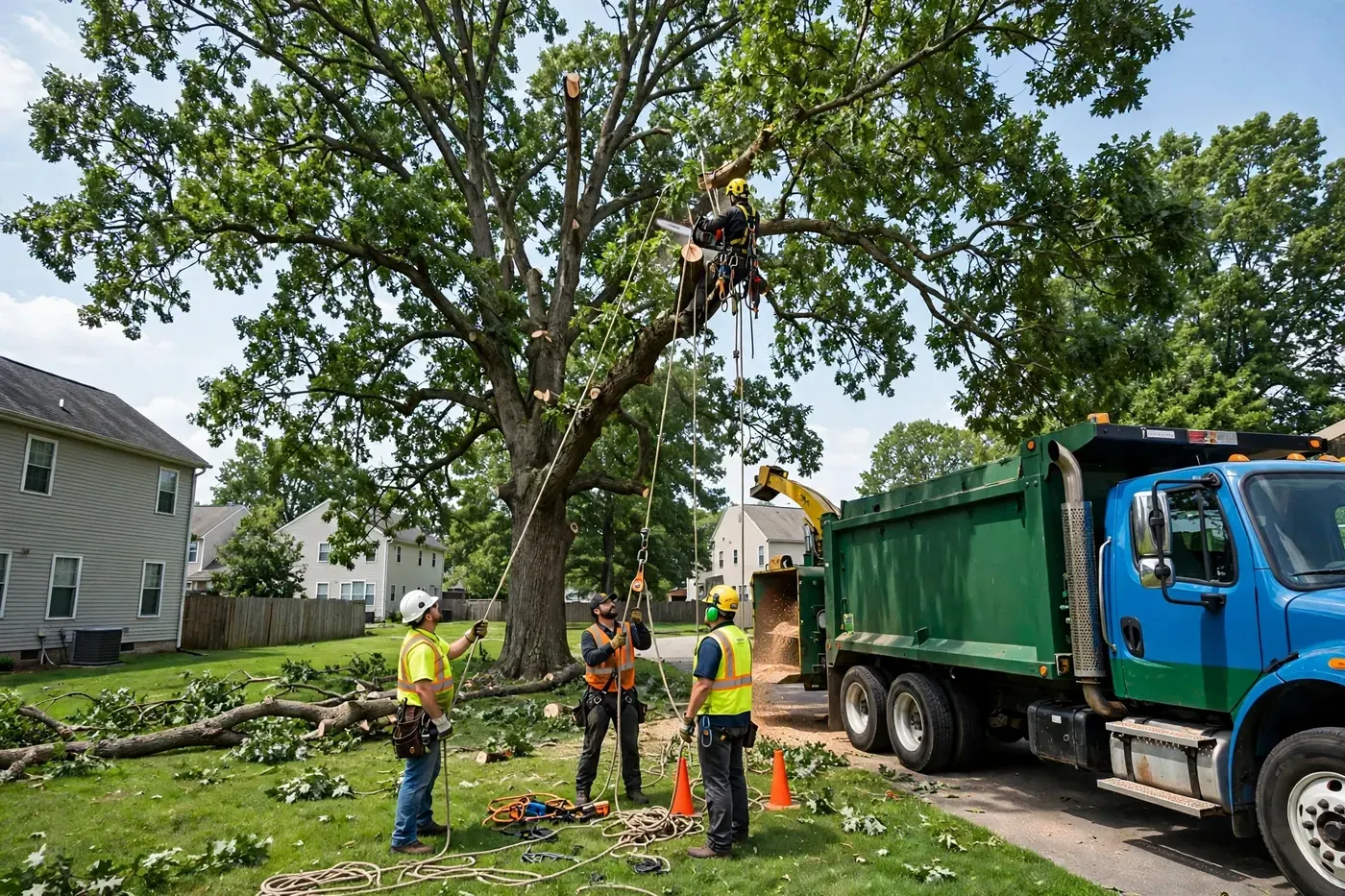
Is your tree dying, or just having a bad year? This is the question we hear most — and it is the one some companies answer with a chainsaw no matter what. Here is our honest take: removal is the last resort, not the first sale. If pruning, cabling, or treatment can save your tree, we will tell you. If the tree has to go, we will tell you that too, and explain why in plain words.
The Honest Rule
A tree is worth saving when its trunk and roots are sound and the problems are only in the branches. A tree has to go when its structure has failed — the trunk, the roots, or both. Everything below is just detail on that one rule.
7 Signs the Tree Has to Go
- It is dead. No leaves in spring or summer, bark falling off in sheets, branches that snap like dry twigs. A dead tree only gets weaker — and heavier — with time.
- The trunk is hollow or rotting. Mushrooms or shelf fungus on the trunk or at the base mean decay inside. A tree can look solid and be hollow. Tap the trunk — a hollow sound is a bad sign.
- The roots are failing. A new lean, soil cracked or lifted on one side, or mushrooms around the base. Roots are the tree's foundation. When they go, the tree follows.
- The trunk is split through. A deep crack that goes through the bark into the wood, especially with decay around it. Some cracks can be cabled. A split trunk usually cannot.
- Big sections of the crown are dead. When half or more of the canopy is gone, the tree cannot feed itself. It will not recover.
- Storm damage went too far. Uprooted, trunk snapped, or most major limbs torn off. Pruning can fix broken limbs — it cannot fix a broken trunk.
- It threatens what you cannot move. Roots cracking your foundation, a lean aimed at the house that keeps getting worse. Sometimes the tree is fine and the location is the problem.
3 Signs It Can Be Saved
- The trunk is solid. Bark intact, wood firm, no fungus, no hollow sound. A solid trunk with bad branches is a pruning job, not a removal.
- The damage is only in the limbs. Dead branches, storm-torn limbs, a lopsided crown. Clean pruning cuts remove the bad wood and the tree grows on.
- It is stressed, not dying. Thin leaves, slow growth, early fall color. Stress has causes — packed soil, pests, disease — and many of them are treatable. See our tree health inspections page.
When Pruning or Cabling Is the Answer
Pruning removes dead, diseased, or damaged limbs so the healthy wood thrives. Cabling adds steel support to a tree with a weak fork or a cracked heavy limb — it can give a good tree many more safe years. Both cost far less than a removal, and both leave you with the shade, the looks, and the property value a mature tree brings. See tree pruning and tree cabling and bracing.
The Real Cost of Waiting
Here is the part nobody likes to hear: waiting on a dying tree does not save money. A planned removal is scheduled, controlled, and priced in writing. An emergency removal after the storm brings it down costs more, happens on the storm's schedule, and can add roof or fence repairs to the bill. When the signs point to removal, sooner is cheaper than later.
How We Decide at Your Free Visit
We walk your yard with you. We check the trunk, the limbs, and the roots — by hand and by eye. Then we give you the straight answer: save it, prune it, cable it, or take it down. If removal is not needed, we say so, and the advice is free. Call (240) 213-4913.
Get your free estimate
Still have a question we did not answer? Call (240) 213-4913 — you will talk to someone local, not a call center. Free on-site visit, written price, no pressure.