
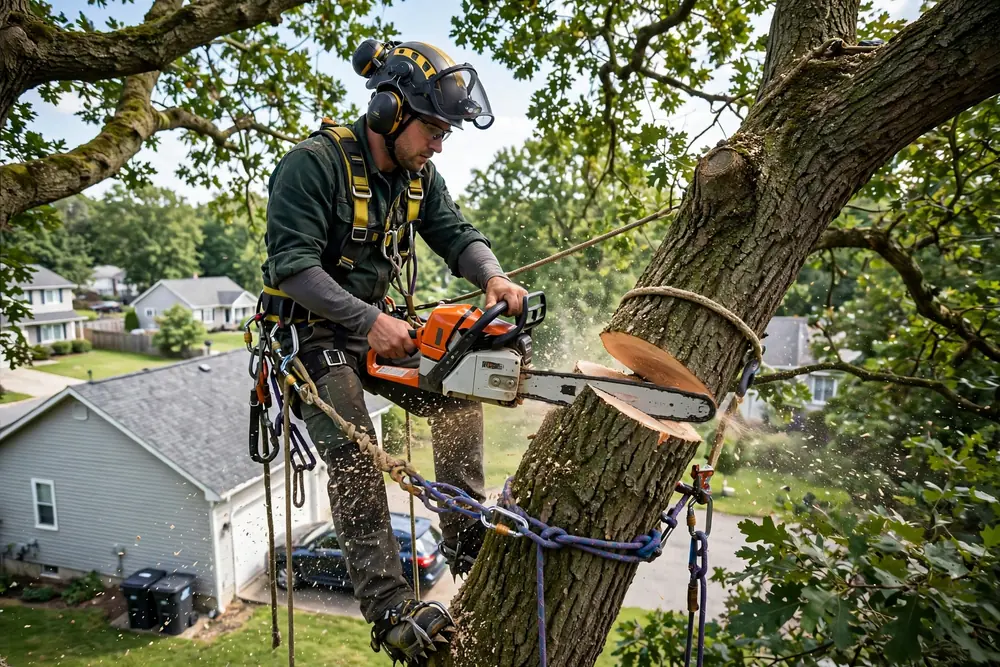
Look up into your big trees. See those gray, barkless branches with no leaves? That is deadwood — dead branches still hanging in a living tree. They do not fall on their own schedule. They wait for the next windstorm, then drop onto roofs, cars, fences, and people. Deadwood removal takes out only the dead stuff, on your schedule, before the weather does it for you. The living tree stays — healthier, safer, and better looking.
What Is Deadwood Removal?
Deadwood removal is the careful removal of dead branches from a living tree — nothing more, nothing less. Trees naturally shed lower limbs as the canopy shades them out, but the big dead branches hang on for years. They turn brittle. They become what tree crews call "widow makers": heavy dead limbs waiting for a gust of wind. They also invite trouble — borers and decay fungi move into dead wood first, then spread to the living tree.
Here is the line that matters: deadwood removal is not the same as pruning. Pruning shapes living limbs too — it thins the canopy, improves structure, and guides how the tree grows. Deadwood removal takes out only the dead branches and leaves every living limb exactly as it is. Think of it this way: deadwooding is safety and cleanup; pruning is health care and shaping. Many mature trees benefit from both, but they are different jobs with different goals. A tree can need deadwooding every couple of years while its live canopy needs no pruning at all. (See tree pruning for the full health-care side.)
When You Need It
- You see gray, barkless branches with no leaves in the canopy.
- Dead limbs hang over your roof, driveway, or children's play area.
- Small dead twigs rain down every time the wind picks up.
- The tree looks healthy except for the dead patches.
- You want the tree safe before nor'easter and summer storm season.
- You are selling the house and the trees look neglected.
- A recent storm left broken, hanging dead limbs that never fell.
How It Works
- Free on-site visit. We walk your property and spot every dead limb, high and low — from the ground with binoculars and up close where we can reach. We check which trees need it most and give you the full picture.
- Written price. You get a clear quote based on the tree's size and how much dead wood is in it. One price for the whole job, in writing, before we start.
- Dead-or-dormant check. This step takes a trained eye. In the growing season it is straightforward: no leaves, and a small scratch test shows brown dry wood instead of green living tissue. In winter it is trickier — a dormant branch and a dead branch can look alike — which is exactly why this job belongs to someone who does it every day.
- Climb or bucket, then cut. The deadwood is reached by climbing or with a bucket truck, and each dead branch is cut back to the collar of living wood — the spot where the tree can seal the wound. We cut only dead wood. Every living limb stays.
- Chip it all and rake up. Dead branches go straight through the chipper. We rake the work area clean. The tree looks alive again, and your yard is safer the same day.
What Affects the Cost?
- Tree size and height. A 25-foot dogwood with a few dead limbs costs less than a 70-foot oak full of deadwood. Height means climbing or bucket time.
- Volume of deadwood. A light cleanup is quick. A tree that has been shedding for a decade takes real hours in the canopy.
- Access method. A tree the bucket truck can reach from the driveway is simpler than one deep in the backyard that needs a full climb.
- Disposal. Chipping and hauling the deadwood is part of the job. Bigger piles mean more chipper time and more hauling.
Every tree is different, so we give a free on-site written estimate. You know the price before a single branch comes down.
Why Not Do It Yourself?
For low dead limbs, honest answer: you can. A pole pruner from the ground handles dead branches up to about 12 feet — cut outside the branch collar, let it fall clear, done. But the dangerous deadwood is the high stuff, and that is not DIY territory. Climbing with a chainsaw to cut dead limbs is one of the most dangerous things a homeowner can do: dead wood is unpredictable, it snaps and swings in ways live wood does not, and a falling dead limb can knock a climber off balance.
There is also the identification problem. Cut a living limb by mistake and you have wounded the tree for nothing. Cut too close to the trunk and the tree cannot seal the wound. If the deadwood is over your roof, your car, or a power line, call a pro — the cost of the visit is nothing next to the cost of a dropped limb through a windshield. For high, heavy, or hard-to-reach deadwood, this is our job, not yours.
Common Deadwood Removal Mistakes
Mistake 1: Yanking hanging limbs down with a rope from the ground. It feels clever until the limb tears a strip of living bark off with it — now the tree has a wound it cannot close, and decay moves in. What to do instead: cut dead limbs cleanly at the branch collar. If you cannot reach it safely, call us.
Mistake 2: "While you're up there" syndrome. The crew is in the tree for deadwood, and someone says "just take those live limbs too." Now your careful deadwood job has become a bad pruning — too much live canopy removed, the tree stressed, the shape ruined. What to do instead: keep the jobs separate. Deadwood now; a proper tree trimming or pruning plan if the live canopy needs work.
Mistake 3: Waiting until storm season. Deadwood plus a nor'easter is how roofs get holes. Calling after the storm means emergency scheduling and storm-damage prices — if you can get a crew at all. What to do instead: deadwood in the calm months. It is cheaper, calmer, and the tree is protected before the wind comes.
Mistake 4: Topping the tree to "get all the dead stuff." Topping — cutting the whole top off — does not remove deadwood properly. It ruins the tree's structure, triggers weak regrowth, and creates more deadwood than it removes. What to do instead: never top. Remove the dead branches individually, back to living wood.
Our Service Area
We serve Waldorf, MD and all of Charles County — including White Plains, La Plata, and Hughesville. Dead branches do not wait for a convenient time, so call us at the first sign and we will come take a free look, usually within a day or two.
Get a Free Estimate
Ready when you are. Call or text (240) 213-4913 — or send our short form and we will call you back.
[Call (240) 213-4913 — tap to call: tel:+12402134913]
Free estimate form: Name | Phone | Service needed
We serve Waldorf, MD and all of Charles County.