
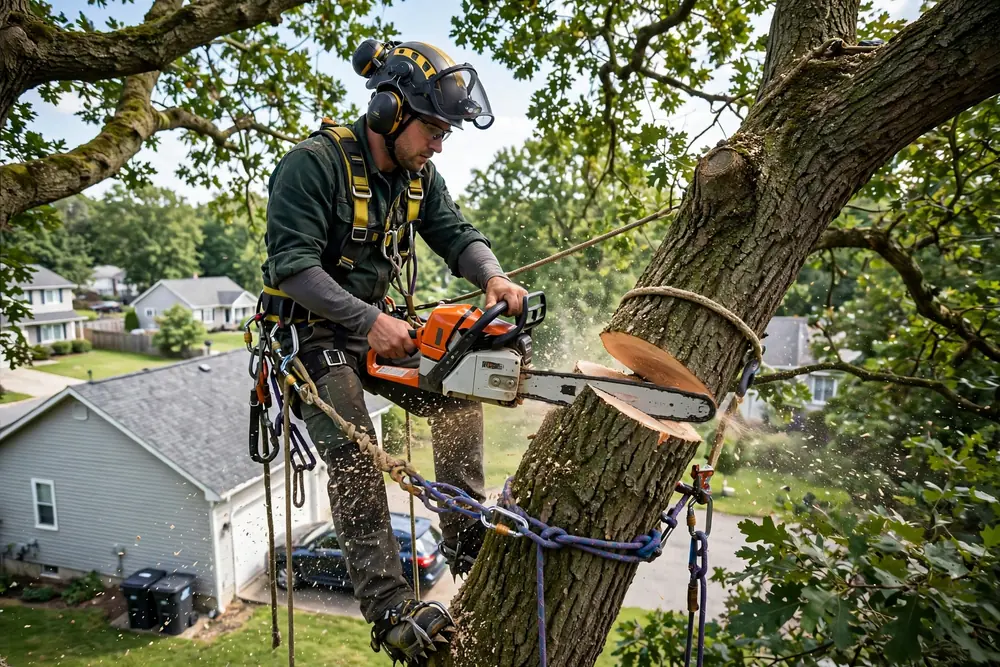
Some trees cannot be cut the normal way. A giant oak leaning over your roof. A pine wedged between two houses. A dead tree too brittle to climb. Dropping pieces — even lowered on ropes — is too risky when your home is inches away. A crane changes the game. We cut a section, the crane lifts it straight up and over your house, and sets it down gently in a clear spot. Nothing swings. Nothing drops. It is the safest way to remove big trees in tight spots — and often the fastest, with most jobs done in a single day.
What Is Crane-Assisted Tree Removal?
Crane-assisted removal is not the same as standard tree removal. A standard removal cuts the tree in sections and lowers each piece with ropes and rigging — that works fine when there is room to swing and drop. Crane removal lifts each cut section straight up and over your home. It is the answer when there is no room to drop or swing anything at all.
Here is how the team works: a climber (or the bucket) positions at the cut point, the crane's cable takes the weight of the section, the cut is made, and the operator swings the piece — called a "pick" — over to a clear drop zone like the street or an open stretch of lawn. The ground crew then cuts it up, chips the brush, and hauls it out. The crane holds every pound, the whole time. Nobody is wrestling heavy wood over your roof.
The crane also solves two problems ropes cannot. First, reach: a bucket truck needs roadside access and tops out around 60 feet — a crane can work from your driveway and reach over the house. Second, dead trees: a brittle, dead tree is not safe to climb, but a crane can pick it apart from above without anyone in it. When the spot is tight and the stakes are high, the crane is the right tool.
When You Need It
- A large tree stands close to your house, garage, or pool.
- The tree is dead and brittle — climbing it is not safe for anyone.
- There is no room to drop limbs or swing rigged pieces in the yard.
- A bucket truck cannot reach the tree from the street.
- The tree is huge and you want it gone in one day, not three.
- A storm left a tree tangled over your roof and it needs to come off cleanly.
- You were told by another company that your tree "can't be done" — it probably can, with a crane.
How It Works
- Free on-site visit and access survey. We check the tree, then we check the crane's path: Is there room for the truck to set up? Is the ground firm enough for the outriggers? Are there overhead wires in the swing path? Do we need mats to protect your driveway? If a crane cannot set up safely, we say so at this visit — not on job day.
- Written price for the full job. You get one quote covering the crane, the crew, the cutting, the chipping, and the hauling. No separate crane bill showing up later.
- Setup day. We lay heavy mats to spread the crane's weight and protect your driveway and lawn. The operator positions the truck and extends the outriggers. The ground crew clears the drop zone and stages the chipper.
- The picks. The climber rigs each section, the crane takes the weight, the cut is made, and the operator swings the pick to the drop zone. Section by section, the tree comes down — over your home, never onto it. The ground crew processes each pick as it lands: logs cut, brush chipped, nothing piling up.
- Same-day cleanup. We chip the brush, haul the logs, and rake the yard. A big tree is gone in a day and the property looks clean. If you want the stump gone too, we can grind it while the equipment is there — just say the word at the estimate.
What Affects the Cost?
- Crane size. A bigger reach or heavier picks need a bigger crane. The crane class is matched to your tree — we do not bring more machine than the job needs.
- Number of picks. A tree that comes down in six big picks costs less in crane time than one needing twenty small, careful picks around wires and rooflines.
- Setup complexity. Tight streets, soft ground needing extra matting, or overhead wires that need the power company's coordination all add planning and time.
- Haul-away volume. A 70-foot oak makes a mountain of wood and chips. Chipping and hauling that volume is real work, and it is in the quote.
Crane removal costs more than a standard removal — the crane is a serious machine with a skilled operator. But compare it honestly: one day of crane work beats days of risky rigging over your roof. Every job is different, so we give a free on-site written estimate.
Why Not Do It Yourself?
There is no DIY version of this job, and that is the honest truth. Crane operation is licensed, skilled work — the operator is managing thousands of pounds swinging over your home. This is not a rental-yard project.
The real question is how to hire it well. Ask who runs the crane and how many crane removals the crew has done. A tree crew that "rents a crane for the day" without real crane-tree experience is gambling with your roof. The climber and the operator have to work as one team — hand signals, timing, weight calls. With over 10 years of experience, our crew knows when a crane is the right call, and just as important, when a standard removal would do the job for less. We will not sell you a crane you do not need.
Common Crane-Assisted Tree Removal Mistakes
Mistake 1: Hiring a crew with no real crane experience. Any tree company can rent a crane. Few have a climber and operator who have worked together on dozens of picks. An inexperienced team is slower, sloppier, and riskier — the exact opposite of why you hired a crane. What to do instead: ask how many crane removals they do in a year, and who operates the crane.
Mistake 2: Skipping the access check. The truck shows up on job day, the street is too tight or the ground too soft, and the job stalls — while you pay for the day. What to do instead: insist on an on-site access survey before you sign. We do ours at the free estimate visit.
Mistake 3: No lawn and driveway protection plan. Cranes are heavy. Without mats, outriggers crack driveways and rut lawns. What to do instead: ask about ground protection up front — what they lay down, and who pays if something still cracks. Our plan is in the written quote.
Mistake 4: Forgetting the stump. The crane leaves, the crew leaves, and a four-foot stump sits in your yard — now a second job with a second trip charge. What to do instead: decide at quote time. Grinding the stump while the crew and equipment are already there costs less than a return visit.
Our Service Area
We serve Waldorf, MD and all of Charles County — including La Plata, Bryans Road, and Indian Head. If a big tree in a tight spot has you worried anywhere in the county, call us for a free look.
Get a Free Estimate
Ready when you are. Call or text (240) 213-4913 — or send our short form and we will call you back.
[Call (240) 213-4913 — tap to call: tel:+12402134913]
Free estimate form: Name | Phone | Service needed
We serve Waldorf, MD and all of Charles County.