
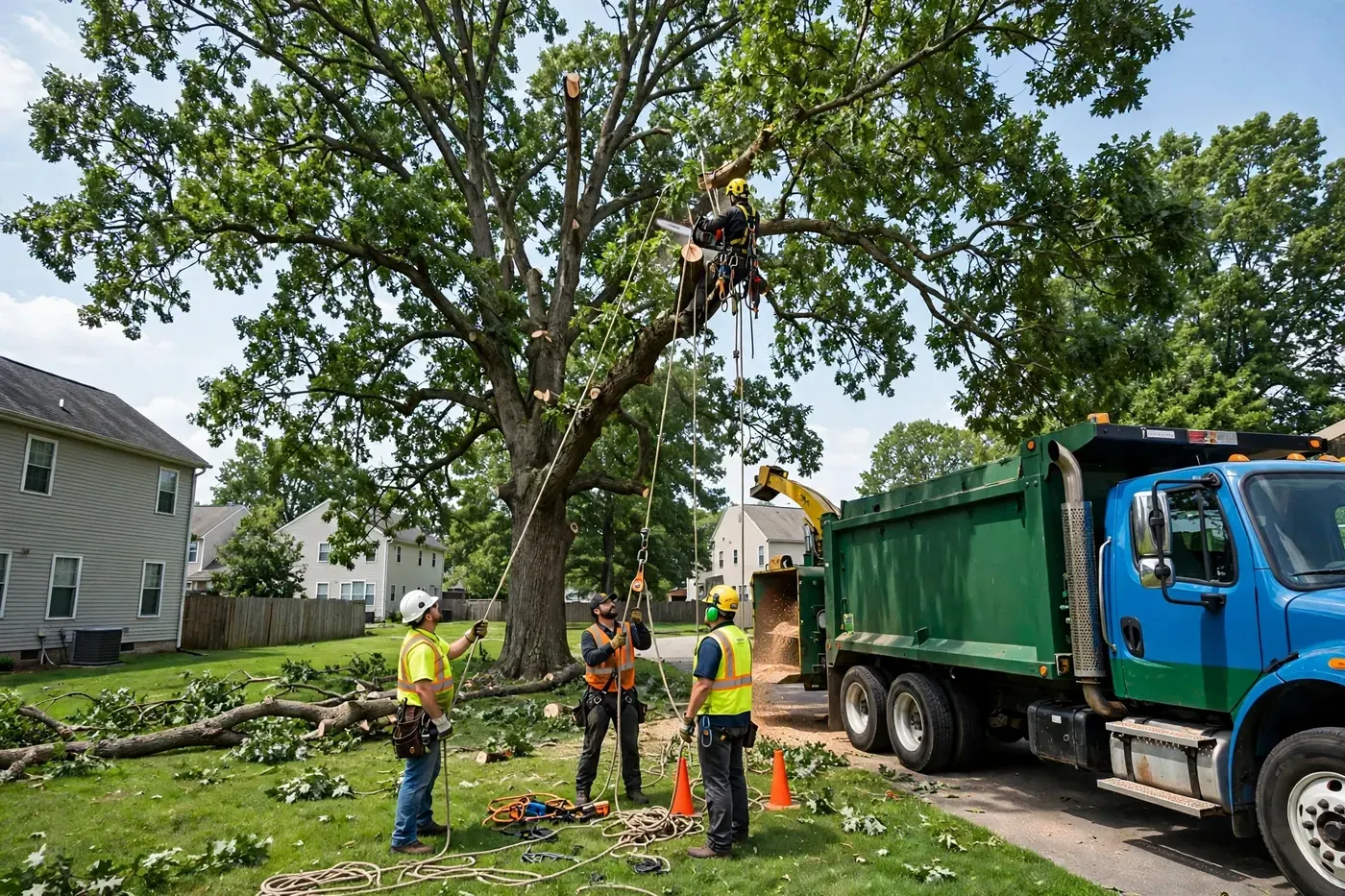
Trees get sick just like people do. Fungus spots the leaves. Rot softens the roots. Cankers eat into the bark. Left alone, a sick tree gets sicker — and a dead tree near your home becomes a hazard.
Treatment fights the disease and helps the tree heal. At Waldorf Tree Services Experts, we prune out the sick limbs, improve the soil and roots, and use targeted treatments for the disease at hand. For some diseases, we use trunk injections — small shots that carry medicine through the tree. The right treatment depends on the tree and the disease, which is why diagnosis comes first.
What Is Tree Disease Treatment?
Tree disease treatment is the work of curing a sick tree — or managing the disease so the tree can live with it. It starts after diagnosis. You would not take medicine before knowing what is wrong. Same with trees: our Tree Health Inspections page covers the diagnosis side. This page is about the treatment itself.
Here is what treatment looks like in plain terms. First, we prune out the infected limbs. Cutting away diseased wood removes the source of the problem and lets air and light into the canopy — fungus hates both. Every cut is clean, because clean cuts heal and torn cuts invite more disease.
Second, we help the roots. A sick tree is often a stressed tree, and stress usually starts underground: compacted clay soil, buried root flares, poor drainage. We loosen the soil, add mulch the right way (never piled against the trunk), and fix what the site is doing wrong. Healthy roots grow a healthy tree.
Third, for some diseases, we treat directly. That can mean a targeted spray on the leaves, a soil drench that the roots take up, or trunk injections — small plugs placed in the trunk that carry medicine through the tree's own system. We match the treatment to the disease. We follow every label direction. And we tell you what to expect: what should improve, how fast, and what to watch for.
Not every tree can be saved. If rot has eaten the trunk or the roots are gone, removal is safer than treatment. We will tell you the truth either way — before you spend a dollar.
When You Need It
Disease shows itself if you know where to look. Here is what to watch for.
- Leaves have spots, blotches, or odd colors that were not there last year.
- Branches die back a little more each year, starting at the tips.
- Bark has sunken spots, cracks, or oozing sores.
- The tree drops its leaves way too early in the season.
- Mushrooms or shelf fungus grow on the trunk or at the base.
- A neighbor's tree had disease, and you want yours protected.
- A tree you love is thinning out and you want to know if treatment can save it.
One rule of thumb: the earlier, the better. A disease caught in year one is often treatable. The same disease in year three may have already won. If something looks off, do not wait for it to look worse.
How It Works
- Free on-site visit. We identify the tree and the disease. Sometimes the diagnosis is clear on the spot — oak wilt, needle blight, canker. Sometimes we need to watch a symptom or check the roots before we name it. We do not guess and we do not rush this step, because the wrong treatment wastes your money.
- You get a written plan and price. The plan names the disease in plain words, lists the treatment steps, and prices each one. It also tells you the honest odds: what treatment can fix, what it can only slow down, and when removal is the safer choice. You decide.
- We prune out the infected limbs. Diseased wood comes out first. We cut back to healthy wood, disinfect tools between cuts so we do not spread the disease, and haul the infected material away — diseased limbs should not sit in your yard or go in the compost.
- We treat what is left. Depending on the disease: a targeted spray, a soil treatment the roots absorb, or trunk injections for diseases that need medicine inside the tree. We time it right — many treatments only work in certain seasons — and we tell you why the timing matters.
- We tell you how to help the tree recover. Water during dry spells. Keep mulch in a wide ring, not a volcano against the trunk. Watch for the signs we show you. Recovery takes time — months, not days — and we tell you what progress looks like so you are not guessing.
For diseases we cannot beat, we say so up front. Then the conversation shifts to safe removal before the tree becomes a hazard. Honesty first, always.
What Affects the Cost?
Four things drive the price of tree disease treatment.
The size of the tree. A small ornamental tree is quick to prune and spray. A 60-foot oak needs more time, more material, and sometimes a lift or a climber to reach the canopy. Bigger tree, bigger job.
The type of treatment. Pruning out a few infected limbs costs less than a full program. Trunk injections cost more than a spray because the material and the labor are specialized. Soil work — aeration, mulch, drainage fixes — is priced by the area. The written plan breaks it out so you see each piece.
How far the disease has spread. One infected limb is a small job. A disease through the whole canopy means more pruning, more treatment, and sometimes repeat visits across seasons. Early catches are cheaper — another reason not to wait.
How many trees need help. Some diseases spread. If three oaks need treatment, the plan covers all three — and treating them together is more efficient than three separate visits. We will tell you which of your trees are at risk and which are fine.
We never quote treatment over the phone. Call (240) 213-4913 for a free on-site visit, a real diagnosis, and a free written estimate.
Why Not Do It Yourself?
Here is the honest version: some tree care is fine DIY. Watering, mulching, and raking up fallen leaves — do all of that. But treating disease is where DIY usually goes wrong.
The first problem is diagnosis. Ten diseases cause yellow leaves. Pick the wrong one and you spray for a fungus when the real problem is root rot. The tree keeps declining, and you have spent money and a season. Pros narrow it down because they have seen the patterns hundreds of times.
The second problem is the products. The effective treatments for serious tree diseases are often restricted — you need a license to buy or apply them. The stuff on the hardware store shelf is made for roses and shrubs, not a 50-foot oak. Trunk injections are not a DIY job at all.
The third problem is safety. Spraying a whole canopy means a ladder, wind drift, and chemicals near your kids, your pets, and your neighbor's yard. We use targeted treatments, follow label directions exactly, and tell you about any wait time before the yard is used again.
Rake the leaves. Spread the mulch. Leave the medicine to us.
Common Disease Treatment Mistakes
Spraying first, diagnosing never. The mistake: you buy a fungicide and spray the whole tree. Why it costs you: if the disease is in the roots or the trunk, a leaf spray does nothing — and you lose a season while it spreads. What to do instead: get the free inspection first. Treat the real disease, once, correctly.
Pruning diseased limbs with dirty tools. The mistake: you cut the sick branches and move on to the healthy tree with the same saw. Why it costs you: many diseases travel on tools. You just infected the next tree. What to do instead: disinfect tools between trees — a quick wipe with alcohol or bleach solution. We do this on every job, and you should too.
Piling mulch against the trunk. The mistake: the "mulch volcano" — a big mound heaped against the bark. Why it costs you: trapped moisture rots the bark and invites disease and pests. It is one of the most common ways homeowners accidentally sicken their own trees. What to do instead: spread mulch in a wide, flat ring — two to three inches deep, starting a few inches away from the trunk.
Expecting overnight results. The mistake: treatment goes down in spring, and by summer you decide it did not work. Why it costs you: you quit on a treatment that was working, or you pay for a second round you did not need. What to do instead: ask us what recovery looks like and how long it takes. Most treatments need a full growing season to show. We tell you the timeline up front so you can judge fairly.
Where We Work
We serve Waldorf, MD and all of Charles County. We treat sick oaks, maples, and pines across St. Charles (/tree-service-st-charles-md/), La Plata (/tree-service-la-plata-md/), and the surrounding towns. If your tree looks sick, call before it gets worse.
Get a Free Estimate
Ready when you are. Call or text (240) 213-4913 — or send our short form and we will call you back.
[Call (240) 213-4913 — tap to call: tel:+12402134913]
Free estimate form: Name | Phone | Service needed
We serve Waldorf, MD and all of Charles County.