
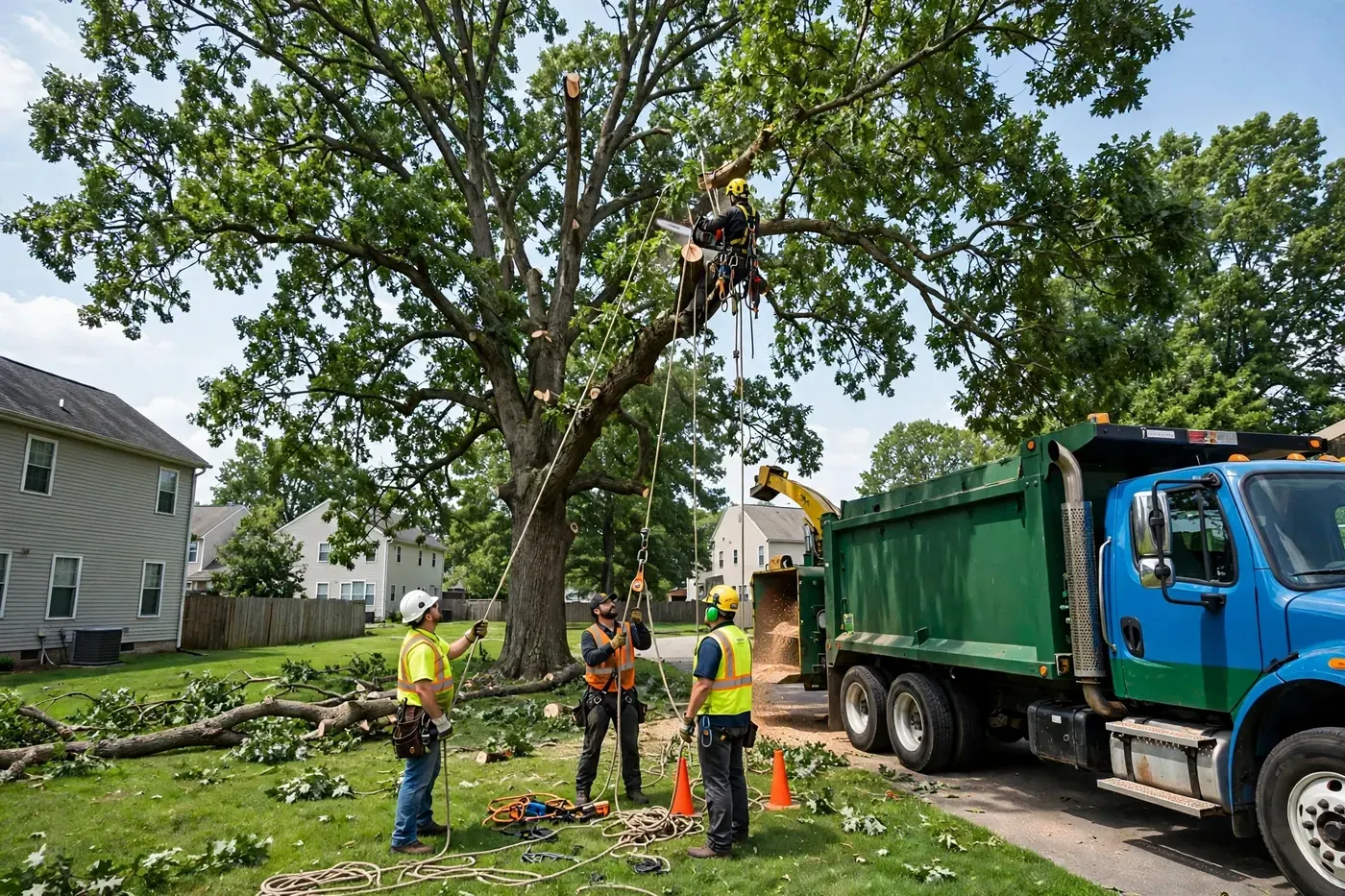
Maryland gets serious thunderstorms, and a tall tree near your home is a natural lightning rod. One strike can split a trunk wide open, blow the bark off in strips, or kill a hundred-year-old oak in a single flash. Worse, lightning can jump from the tree to your house, your fence, or anything wired nearby. A lightning protection system gives that strike a safe path straight into the ground. The tree survives. Your home stays safer. Waldorf Tree Services Experts installs tree lightning protection across Waldorf, MD. Free on-site estimates.
What Is Tree Lightning Protection?
A tree lightning protection system is a simple, proven setup: a copper cable runs from the top of the tree, down along the trunk, and into the ground through one or more ground rods. Copper carries electricity far better than wood. When lightning hits, it follows the path of least resistance — the cable — instead of blasting through the trunk. The energy goes harmlessly into the earth.
This is the same principle behind lightning rods on barns and houses, adapted for a living tree. The cable is held to the trunk with special fasteners that let the tree keep growing without damage. Small air terminals — slim rods — extend above the crown to catch the strike first. Everything is bonded and grounded to accepted standards for tree work. It is a quiet system. Once installed, you will barely know it is there, but it stands guard through every summer storm.
One honest note: no system stops lightning from striking. What the system does is control where the energy goes. A protected tree takes the hit and lives. An unprotected tree takes the hit and often dies — sometimes taking part of your house with it. If you have a tree you cannot replace, this is the cheapest insurance it will ever get.
Which Trees Need It
- Tall trees standing near your home. If the tree is the tallest thing within striking distance of your house, it is the most likely target — and the jump to your roof is short.
- Old, large shade trees you cannot replace. A mature white oak took eighty years to grow. You cannot buy that at a nursery. Protection costs far less than losing it.
- Lone trees in open yards. A single tall tree in the middle of a lawn draws strikes the way a lone umbrella draws rain. Open-grown trees are prime targets.
- Trees with a history of storm damage. A tree that has been hit or scarred before is not "used to it." Old wounds make the next strike worse.
- Trees near things you value. Play sets, pools, detached garages, fences with metal gates — if a strike jumping from the tree could reach something important, the tree is worth protecting.
- Historic or sentimental trees. The oak your kids grew up climbing has value no price tag covers. Protect it.
Not every tree needs a system. Short trees tucked under taller ones, small ornamentals like dogwood and redbud, and trees far from anything valuable are usually fine without. At your free visit, we will tell you straight which of your trees are worth protecting — and which are not.
How It Works
- Free on-site visit. We look at your tallest, most at-risk trees. We check their height, their distance from your home, and what sits underneath them. You get an honest read on which trees need protection.
- You get a written price. One clear quote per tree. No surprises.
- We install the system. A climber runs the copper cable from above the crown down the trunk, securing it with tree-friendly fasteners that allow for growth. Air terminals extend past the top. At the base, the cable connects to ground rods driven deep into the earth. On big trees we may run more than one down-conductor for full coverage.
- We test and tidy up. We check every connection and ground point, then clean up the work area. The cable is thin and follows the trunk — most people never notice it.
- We check it yearly. Trees grow and weather happens. A quick annual look keeps the system tight and working. Ask us about a yearly check when we install — it takes minutes and keeps the protection real.
What Affects the Cost?
Three factors shape the price. Tree height matters most. A taller tree needs more cable, more climbing time, and often more than one down-conductor to cover the full crown. A 40-foot pine and an 80-foot oak are very different jobs. Number of trees is second — protecting three trees in one visit costs less per tree than three separate visits.
Access and ground conditions round it out. A tree in an open yard is straightforward. A tree wedged between the house and a fence takes more rigging. Hard, rocky ground makes driving ground rods slower. The species matters a little too — a straight pine trunk is faster to cable than a spreading oak with a wide, complex crown.
Every tree is different, so we quote on site, in writing, for free. Call (240) 213-4913 for a free on-site written estimate — you will know the full price before we climb.
Why Not Do It Yourself?
This is one job we do not recommend as DIY, and here is why. First, the work happens at the very top of a tall tree — the most dangerous part of the tree to reach, often 60 to 80 feet up. Professional climbers train for this. A homeowner on a tall ladder with a spool of copper cable is a bad combination.
Second, the system has to be right to work at all. Ground rods must reach proper depth. Connections must be tight and corrosion-proof. The cable path must actually be the path of least resistance. A sloppy install looks protective and does nothing — which is worse than no system, because you stop worrying.
Third, mixing a tree system with anything electrical near your home needs care. Done wrong, a strike can travel where you do not want it. This is skilled, high work with real electrical principles behind it. Leave it to a crew that does it properly.
Common Lightning Protection Mistakes
Protecting the wrong tree. Homeowners often ask us to cable a medium tree while the 90-foot oak towering over the house goes bare. Lightning picks the tallest target. What to do instead: protect the tallest trees nearest your home first. We will rank your trees by risk at the free visit.
Installing it and never checking it again. Trees grow. Fasteners loosen. Ground connections corrode. A system nobody looks at for ten years may not work when the storm comes. What to do instead: get a quick annual check. It takes minutes and keeps the system honest.
Thinking it stops lightning. No system prevents a strike — it only controls the damage. A homeowner who believes the tree is "lightning-proof" may ignore other risks, like dead limbs over the roof. What to do instead: pair protection with good tree care. See tree risk assessment for the full safety picture.
Waiting until after the first strike. We get this call every storm season: the tree was hit, half the bark is gone, and now they want protection. Sometimes the tree can still be saved — sometimes it cannot. What to do instead: protect valuable trees before storm season, not after the damage. Summer storms arrive every year in Charles County.
Where We Work
We serve Waldorf, MD and all of Charles County — including La Plata, St. Charles, Indian Head, and nearby towns. Call and we will come take a look, free of charge.
Get a Free Estimate
Ready when you are. Call or text (240) 213-4913 — or send our short form and we will call you back.
[Call (240) 213-4913 — tap to call: tel:+12402134913]
Free estimate form: Name | Phone | Service needed
We serve Waldorf, MD and all of Charles County.