
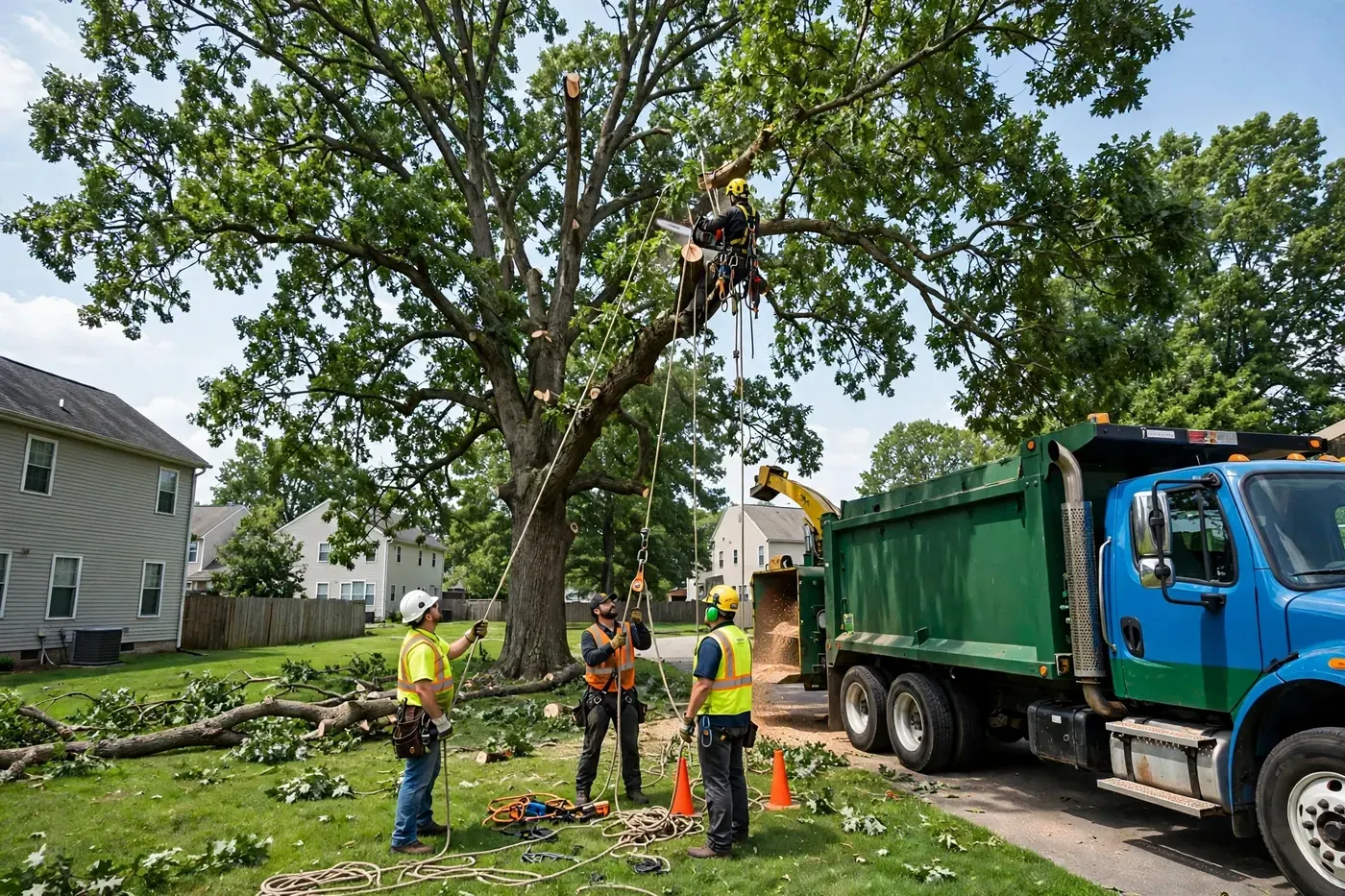
What will my tree work cost? It is the first question almost every homeowner asks. This guide gives you honest, plain-English answers: the typical ranges homeowners pay for tree removal, trimming, and stump grinding, what pushes your price up or down, and what is different about tree work here in Waldorf, MD.
Read this first: the dollar ranges below are typical national ranges published by cost guides like HomeAdvisor — not quotes for your yard. Every tree and yard is different, so your price can land lower or higher. The only real number comes from a free on-site estimate. We come look at your tree and give you a written price before any work starts.
How Much Does Tree Removal Cost?
Most homeowners pay between $200 and $2,000 to remove a tree, according to HomeAdvisor's cost guide. The national average sits around $750 to $900. The single biggest factor is the size of the tree — a bigger tree means more time, more crew, and bigger gear.
Here is how removal prices usually break down by tree size (from a 2026 national tree-pricing guide):
- Small tree (under 30 feet tall): $150 to $450. A young tree in an open yard. Quick work, small crew.
- Medium tree (30 to 60 feet tall): $285 to $700. The most common residential job. A day's work for a crew with a chipper.
- Large tree (60 to 80 feet tall): $700 to $1,200. Mature oaks and maples. Ropes, rigging, and careful sectioning to protect what is below.
- Very large tree (over 80 feet tall): $1,000 to $2,000 or more. Big, old trees — especially ones leaning over a house or tangled near power lines.
Those are national figures. A tricky tree in a tight Waldorf backyard can land above the range; a simple tree in an open field can land below it. That is exactly why we do free on-site estimates instead of guessing over the phone.
How Much Does Trimming and Pruning Cost?
HomeAdvisor reports that most homeowners spend $400 to $800 for pruning work. Trimming averages about $460, with jobs ranging from $75 to $1,800 depending on what is involved.
A quick trim of one small tree — cutting back a few limbs over the driveway — sits at the low end. A full crown cleanup on a big oak, with deadwood removed and the whole tree shaped, sits at the high end. Regular pruning every few years costs less per visit than letting a tree go wild for a decade and then fixing it all at once.
How Much Does Stump Grinding Cost?
HomeAdvisor puts professional stump removal at $195 to $600, depending on the size of the stump and how hard it is to reach. Many companies price grinding by the inch — roughly $3 to $5 per inch of stump width — or charge a flat $150 to $450 for a standard stump.
Two money tips: adding stump grinding to a removal costs less than booking a separate visit later, and you can ask for the grind to go a few inches deeper if you plan to plant grass or a new tree in that spot.
What Makes Your Price Go Up or Down?
Two neighbors with the same size tree can get very different quotes. Here is why:
- Where the tree sits. Open yard is easy. Leaning over your house, fence, shed, or power lines takes ropes, rigging, and more time.
- Access. If a truck and chipper can pull right up, the job moves fast. If everything must be hauled by hand through a side gate, labor time climbs.
- Tree health. Dead or storm-damaged wood is brittle and unpredictable. The crew must work slower and plan more carefully.
- Crane work. When a tree cannot be climbed safely, a crane does the lifting. Crane time typically runs $300 to $600 per hour.
- Emergency timing. After-hours, weekend, or same-day storm work can cost 20% to 50% more than a scheduled job. Ask the price up front and get it in writing.
- Cleanup. Chipping, hauling logs, and raking the yard are real labor. Ask that cleanup is spelled out in the written price — not added as a surprise line item.
- Stump grinding. Often a separate add-on. Bundling it with the removal almost always beats two separate visits.
- Permits. Some towns require a permit to remove certain trees. Routine residential work in Waldorf rarely needs one, but trees near streams, wetlands, or protected areas can be a different story — when in doubt, check with Charles County before work starts.
Waldorf, MD: Local Things That Affect Your Price
National ranges are a starting point, but local reality moves the number:
- Big old oaks and maples. Charles County yards are full of them. They live long and grow wide, which is why most Waldorf homeowners land in the medium-to-large pricing tiers, not the small ones.
- Storm season. Spring storms, summer downbursts, and fall hurricanes hit Southern Maryland hard. After a big storm, emergency calls go first and prices reflect the rush. Booking routine trimming before storm season is cheaper than calling after one.
- Tight lots. Neighborhoods in St. Charles, White Plains, and La Plata often have small backyards with limited truck access. More hand-hauling means more labor time than the same tree in an open field.
- Pine removals after storms. Tall pines snap in high wind. A snapped pine leaning on a roof is urgent work — expect the emergency side of the pricing, not the routine side.
How to Get a Fair Price
- Get two or three written quotes for the exact same scope of work. Quotes for identical tree work often vary a lot between companies.
- Compare scopes, not just prices. Does the quote include chipping, hauling, raking, and stump grinding? A cheap quote with cleanup "extra" is not cheap.
- Ask for proof of insurance — both general liability and workers' comp. No certificate, no deal.
- Never pay the full amount up front. A deposit is normal; full payment before the work starts is not.
- Be wary of the lowest bid. Tree work done cheap near your roof — no plan, no rigging, no insurance — is dangerous. The cheapest quote can become the most expensive mistake.
Your Real Number Is Free
Guides and ranges only get you so far. The real number for your tree comes from someone standing in your yard looking at it. That visit is free, the written price is free, and there is no pressure to say yes.
📞 Call (240) 213-4913Get My Free Estimate
Cost ranges on this page are typical national ranges from HomeAdvisor's cost guides and a 2026 national tree-pricing guide — published figures, not quotes. Your price depends on your tree, your yard, and the work involved. Free on-site estimates give you the real number.