
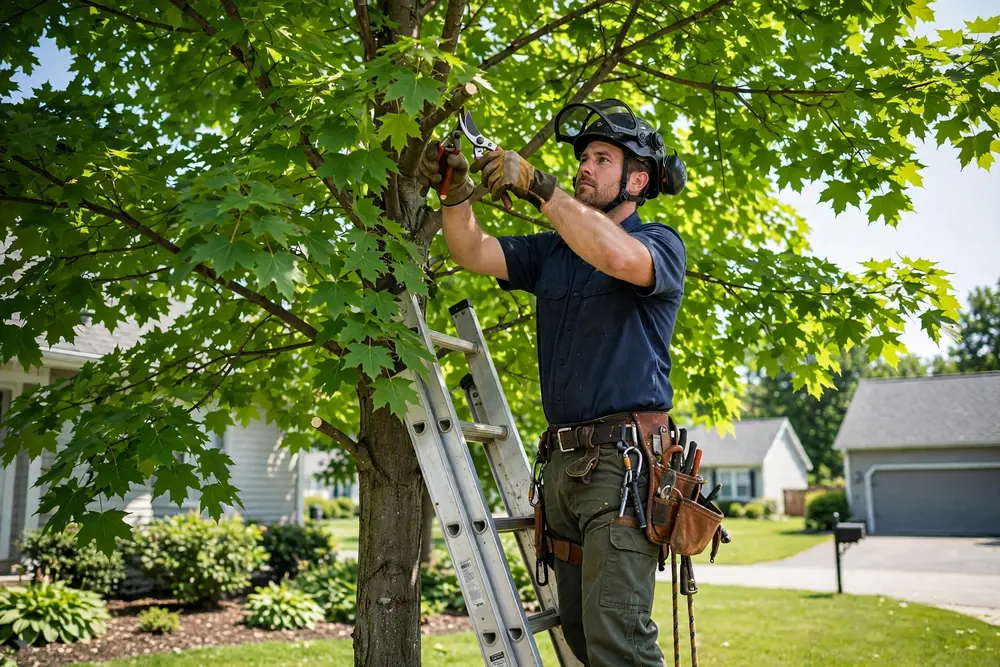
Your trees are some of the most valuable things in your yard. A mature oak shades your home, cuts your summer cooling bills, and makes the whole property look better. But dead and diseased limbs drag a good tree down. They invite rot, spread sickness to healthy limbs, and snap off in the next storm. At Waldorf Tree Services Experts, our pruning is health care for your trees — we cut out what is dead, sick, or damaged so the rest of the tree can thrive. Call or text (240) 213-4913 today for a free on-site written estimate.
What Is Tree Pruning?
Pruning is health care for trees. We remove dead, diseased, and broken limbs. We cut out branches that cross and rub against each other. We clear water sprouts — the weak, fast shoots that crowd the trunk. Every cut is made at the right spot, just outside the branch collar, so the tree seals the wound on its own and heals fast.
Good pruning helps oaks, maples, and pines live longer. It lets air and light into the canopy, which fights fungus and disease. It also takes the weak limbs out before a nor'easter or summer storm takes them out for you — hopefully not onto your roof.
Pruning is not the same as trimming. Trimming shapes the tree and clears space around your home — it is about looks and clearance. Pruning is about health. Many trees need both, and we will tell you straight which yours need.
Related: need shape and clearance instead? See our tree trimming page. Tree too far gone? See tree removal.
When You Need It
- You see dead branches with no leaves while the rest of the tree is green.
- Limbs are cracked, hanging, or broken after a storm.
- Branches cross and rub against each other, wounding the bark.
- The tree looks thin, lopsided, or grows heavy on one side.
- You spot fungus or mushrooms growing on the bark — a sign of decay inside.
- Small dead twigs drop from the tree all season long.
- You want the tree strong and storm-ready before nor'easter season.
If your trees show any of these signs, call (240) 213-4913. We will check each tree limb by limb and give you an honest read — including when pruning is not enough and removal is the safer call.
How It Works
- Free on-site visit. We walk your property and check each tree limb by limb. We look for dead wood, disease, crossing branches, and storm damage. We also check how the tree grows — some "problems" are just how that species looks.
- You get a written price and a clear plan. We tell you what we will cut and what we will leave, and why. No jargon. You approve the plan before we start.
- We prune with sharp tools and proper cuts. We start with the dead and dangerous limbs. Then the diseased wood — cutting back into healthy wood so the sickness does not spread. Then the structural cuts: crossing limbs, rubbing branches, weak sprouts. Every cut is made at the branch collar, the tree's natural healing point.
- We disinfect tools between sick trees. This matters. A dirty saw can carry disease from a sick tree to a healthy one. We clean our tools between trees, and we haul diseased wood away from your property so it cannot re-infect your yard.
- We chip the brush and rake up. Nothing is left behind. We do a final walk-through with you so you can see what was cut and why.
What Affects the Cost?
Number and size of trees. One young maple is a quick visit. Three mature oaks take a full crew day. More trees, more time.
How much dead or diseased wood there is. A light maintenance prune is fast. A tree full of dead limbs and storm damage takes more cuts, more hauling, and more care.
Tree height. Tall trees may need a climber or a lift. Safe access to the upper canopy takes setup time, and we never rush it.
Disease work. Pruning diseased trees takes extra steps — disinfecting tools between cuts and hauling infected wood away from the property so the sickness does not spread. That care is part of the job.
Access. Tight gates, soft lawns, and trees behind the house add hand-carry time.
Call (240) 213-4913 for a free on-site written estimate. We will show you the plan and the price in writing.
Why Not Do It Yourself?
The wrong cuts are the big risk. Leave a stub and it rots back into the trunk. Cut flush against the trunk and the tree cannot seal the wound. Bad cuts made today cause decay you will not see for years.
Dirty tools are the second risk. Pruning a sick tree with a saw, then using that same saw on a healthy tree, spreads the disease. Pros disinfect between trees.
Climbing is the third risk. Dead limbs are brittle and break under weight. A limb you stand on can snap without warning.
Then there is the "how much" question. Homeowners often cut too much, too fast — and a tree that loses too many leaves in one year cannot feed itself.
Small dead twigs you can reach from the ground? Snip them off. Anything bigger, higher, or possibly diseased is a crew's job.
Common Tree Pruning Mistakes
Topping the tree. The mistake: cutting the top off flat to "keep it small." Why it costs you: the tree sends up a burst of weak shoots that grow fast and break in storms. The shape is ruined for good. What to do instead: proper crown work by a trained crew shortens limbs the right way and keeps the tree's natural form.
Cutting too much in one year. The mistake: stripping the canopy bare to "let in light." Why it costs you: leaves are how the tree feeds itself. Remove too many and the tree stresses, weakens, and grows poorly. What to do instead: spread big pruning over two or three years. A good crew tells you when to stop.
Painting cuts with tar or sealant. The mistake: smearing wound paint on every cut because "that is how it was always done." Why it costs you: sealants trap moisture against the wood and can slow the tree's own healing. What to do instead: make a clean cut at the branch collar and let the tree seal itself — that is how trees are built to heal.
Hiring someone who only knows how to cut. The mistake: picking the cheapest "tree guy" who cannot tell dead wood from healthy growth. Why it costs you: he removes the wrong limbs, leaves the dead ones, and the tree is worse off. What to do instead: ask what they plan to cut and why. A real pruner can explain every cut.
Pruning Trees Across Charles County
We prune trees all over Waldorf, MD and Charles County — La Plata, Bryans Road, and St. Charles every week. See our tree service in Bryans Road page for that town. Call (240) 213-4913 today for a free visit.
Get a Free Estimate
Healthy trees start with the right cuts. Call or text (240) 213-4913 for a free visit — we will check your trees limb by limb and give you a written price and a clear plan. No pressure.
Or send our short form — Name | Phone | Service needed — and we will call you back.
[Call (240) 213-4913 — tap to call: tel:+12402134913]
We serve Waldorf, MD and all of Charles County.